Showing posts with label reproductions. Show all posts

Monday, March 3, 2014

Inspired by H.M. Trevor's The Fisherman's Mother

Inspired by The Fisherman's Wife Stage One
During the course of the last two years while researching my ancestors, I discovered that farming was the predominant occupation of my paternal ancestors - that is - until they emigrated to Boston, Massachusetts.   There, far from their farming roots, they took on a variety of occupations becoming pipefitters, longshoremen and nurses.     Some of my mother's paternal ancestors were from Canada and made their living in occupations related to the sea, mostly fishermen.  

Inspired by The Fisherman's Wife

I was immediately drawn to a painting at the National Gallery in Dublin and I took a photograph of it, which inspired this painting.    The original painting was done by Irish artist Helen Mabel Trevor in 1892.   She was fascinated by the fishing culture of Brittany and particularly the strength of the women whose husbands and sons faced the dangers of sea.   The rosary beads and cane complete the image of an elderly woman who has experienced a lifetime worry, though tempered with piety, and the years are plainly displayed on her face.


Monday, April 8, 2013

The Concert Reproduction - Post 5 and Final

Have you seen this painting?   If you spot the original in your grandmother's attic or a flea market, and, it is in good condition - and - you can point the authorities to it, you may be able to collect the reward money - a mere $5 million.   You can read much more about the famous heist at the following website.

http://www.gardnermuseum.org/resources/theft

Meanwhile, if you have been following my blog posts on "The Concert", you have seen the development of my copy of the painting.   Its dimensions are just about the same as the original, an odd 28.5 X 25.5 inches.   The "almost" square size was the one that Vermeer liked, but of course, with his mastery of composition, he could make any size work.

My version of the painting is now mounted on the stretcher frame that my husband made (see Post 4).   It literally sounds like a bass drum when tapped.   Once it was mounted on this final support, I finished up by cleaning up the edges, downplaying the paintings on the wall, and adding some scumbling to the wall to hopefully bring the brightness from the left windows to life.

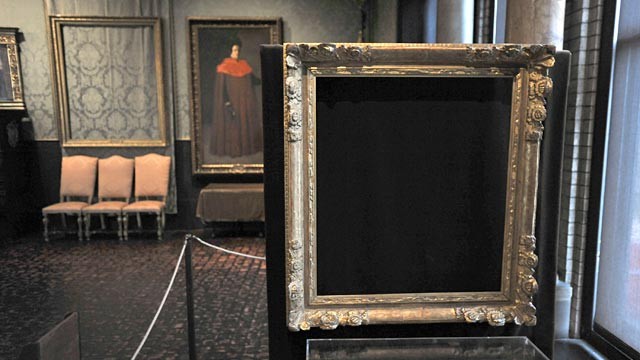
PHOTO: Empty frames
Empty Frame at Gardner Museum "The Concert"
I scoped out the framing options and discovered that a frame that the original's frame, the one that sits empty in the Gardner Museum would cost at least $3,000.   Not bloody likely!   I ordered an ornate gold frame that has some similarities to the empty one in the photo to the left.

So what did I learn from this experience?

Vezina Reproduction of Vermeer's "The Concert"
There was significant planning done by Vermeer in creating the composition.   The painting depicts the three music enthusiasts, but the interpretations of their relationships, given the paintings on the wall, have created multiple theories.   Interesting paintings don't spell everything out.

From a technical perspective, the geometric interest and alignment that Vermeer created by way of the linear elements such as the square pictures on the walls, the marble floor tiles and the placement of the subjects squared to the walls is a way to introduce complexity and even control how the viewer scans the painting.

As for colors and pigments, I learned that mimicking the painting from a modern day image is hardly an accurate representation of the painting from back in the 1600's.    Vermeer's favorite pigment, ultramarine blue, is almost absent from his works, including "The Concert."   One expert theorizes that the expensive blue was used in the painting, but has deteriorated to the point of barely seeming blue.   The flesh tones that look greenish in the digital images are also thought to be the result of deteriorated vernillion and yellow lake pigments.

The lessons do not end here, but the blog posts do as this is the final post on this painting.  If you paint, try a reproduction.   I guarantee you will be glad you did.


Tuesday, March 26, 2013

The Concert Reproduction - Post 4

Custom Stretcher Frame
I continue to push to finish my copy of Vermeer's famous painting, "The Concert."     This week the infamous Gardner Museum heist which resulted in this painting's disappearance is in the news again.   The Boston FBI announced that it has a "high degree of confidence" that they know who was involved and also that the stolen art was taken to Connecticut and Philadelphia.   They are asking for anyone with information to come forward with the reminder that there is a $5 million reward at stake.  After the labor that went into this reproduction, I would love to see the original someday!

For further FBI information, follow this link:

Close up of stretcher bar corner
http://www.fbi.gov/boston/press-releases/2013/fbi-provides-new-information-regarding-the-1990-isabella-stewart-gardner-museum-art-heist


The Concert Repro Dismounted
My husband built a custom stretcher frame to the precise measurements of the painting (28.5 x 25.5 inches).  To the right is a closeup of the corner with brace.   The outer edge is capped with a narrow strapping that protrudes by 1/16th of an inch.  This is to allow a clearance between the canvas and the wood frame

The painting is sitting on the couch waiting to be mounted.

Thursday, March 14, 2013

The Concert Reproduction - Post 3

The Concert After Vermeer (Vezina Reproduction) - Stage 5
There are three embedded paintings in Vermeer's painting "The Concert."   Opinions differ as to the motivation for Vermeer deciding to include these three contrasting works of art within his painting.     

On the wall to the left in a black frame is a landscape painting thought to be the work of  of Jacob van Ruisdael, although writings on the painting do not offer a specific title.    He was known for his rugged landscapes that were painted in the same manner of this painting. 

On the wall to the right is a painting of The Procuress by Dirck van Baburen. The subject of this painting-within-a-painting seems to suggest that something improper is taking place, specifically the procuress playing the lute, her turbin wearing handler and the dark bearded customer.  The question it does the inclusion of this painting suggest an inappropriate scene in the primary painting scene as well?   This theory is disputed by many since The Procuress was in fact owned by Vermeer’s family. Moreover, the figures in the room are intently preoccupied with their music: they do not look at each other, and seem unaware they are being observed or painted.

The third embedded painting is on the harpsicord lid which is in the open position.  According to experts, the harpsichord with the idyllic landscape on its lid was almost certainly manufactured by the renowned Ruckers family in Antwerp with an original landscape by Jan Wildens.

In my reproduction of The Concert I decided to use reference photos of the wall paintings in all their colorful detail instead of trying to copy the very muted versions of the paintings from within my reference photo of The Concert.  I depicted the two wall paintings brightly and colorfully as backdrops for the main painting.    Perhaps Vermeer would cringe at how bright they look and consider them a distraction.   Perhaps I will dull them down at the end, but not yet.  Much color fading has taken place in this painting over the last 350 years, so can anyone say for certain how vibrant the colors were when it was first painted?

Here is my reproduction version of The Concert - still a work in progress. 


Tuesday, February 5, 2013

The Concert Reproduction - Post 2

Concert After Vermeer - Stage 4
I have my Concert replica canvas on a dedicated easel in my studio where I expect it will be for several more weeks.  I am working on other paintings too, but each day I devote some time to the replica.  The painting size is large enough that I can work on a small area at a time as time permits.  When I think of Vermeer, I think of a muted color palette.   However, I just found a better photo than the one I started with and it is quite colorful.   I decide to use the first photo for drawing reference and use the better photo for color.    I like the colors that are starting to vibrate all around the painting.  It's too bad the stolen original is not available for live viewing! 

Monday, February 4, 2013

The Concert Reproduction - Post 1

Toning Raw Umber - Stage 1
The Concert - Johannes Vermeer
Did you know that there is a $5 Million dollar reward for information leading to the recovery of the art that was stolen from the Isabella Stewart Gardner Museum back in March of 1990?  

Among the paintings stolen from the Isabella Gardener Museum in Boston in that infamous theft was a Johannes Vermeer painting entitled, "The Concert."   Of all the paintings stolen, including Rembrandt's "Storm on the Sea of Galilee" and "A Lady and Gentleman in Black",  "The Concert" is considered by some experts to be the painting having the highest monetary value.

You may have seen my prior post which discusses a watercolor done by copying an image of Rembrandt's  "Storm on the Sea of Galilee."    A full 25% of the total views of my blog are the result of a search engine hit on "Storm on the Sea of Galilee."   I see this fact as proof that there are a lot of people out there doing remote queries in search of a painting that could lead to a $5M score!

Sketch in Paint - Stage 2
On my website I have other reproductions such as Fog Warning by Winslow Homer, El Jaleo by John Singer Sargent and an outdoor work inspired by Monet's Poppies at Argentuil.  It was educational and inspiring to paint these phenomenal art treasures.   There is no better way to study a work of art than to paint every last detail of it for yourself.

My goal in painting "The Concert" was to better understand Vermeer's palette and processes.  I cut, marked and mounted a canvas that was exactly the size of the original (28.5 x 25.5 inches).   Since this was a non-standard size, it was mounted on a slightly bigger customized frame, and as a result, there was extra canvas at the top and bottom.  See Stage 2 photo.


It seemed overwhelming at first, so I decided to start with the floor and walls. The black and white tile floor required careful measuring in achieving the proper perspective.   There were white tiles in shadows that were nearly as dark as the black tiles in light.   I concentrated more on the accuracy of the black tiles since the white tiles could be painted after the black tiles dried without extraordinary care by way of overlapping brushstrokes.

After Vermeer - Stage 3

As for the walls, after each painting session, I would rub out the remaining color of my grayer, duller, "dirty" brushes to cover the wall.  A smoky muted look started to develop which is characteristic of Vermeer's work. 

There was so much to learn and paint from this masterpiece.  There will be multiple posts on this one.


Sunday, January 15, 2012

Storm on the Sea of Galilee

The Isabella Stewart Gardner Museum in Boston is reopening tomorrow for members!   The Gardner Museum has been closed since November 15, 2011  During this period, the museum has been completing the final stages of construction and preservation work—including the restoration of the Tapestry Room and a decade-long upgrade of lighting in the historic galleries. Museum staff have also moved a number of visitor-related and administrative functions to the new building and have installed three opening exhibitions. The closure period for the public will end on Thursday, January 19, 2012 when the museum opens the Renzo Piano wing and refreshed historic galleries to the public.  
http://www.buildingproject.gardnermuseum.org/

El Jaleo Reproduction
Even if the weather and busy schedules don't permit frequent in-person visits, the Gardner has one of the best websites I have ever seen.  Their "Explore" function allows a room by room virtual walk through.  Zoom in and out for the most amazing look at minute details of your favorite paintings, and their entire collection.   I wish I had known about the Explore feature when I was tried to create the following reproduction of John Singer Sargent's "El Jaleo,"  my favorite painting.

Storm on the Sea of Galilee
For many the Gardner Museum is best known as the site of one of the world's most famous unrecovered art thefts.   The Storm on the Sea of Galilee was painted by Rembrandt during the 1630's.  It is considered by many to be his most dramatic work, and his only known seascape.   The work is oil on canvas measuring 62.5 inches by 49.6 inches.   The twenty seven year old Rembrandt depicts Christ and his disciples aboard the small boat during an intense and violent storm.

The watercolor below is a practice sketch for a future oil reproduction that I would like to attempt.  What better way to study and appreciate the masterful genius of Sargent and Rembrandt than to paint every last detail of their work for yourself.   The lowly result cannot compare to the original, but I found it thoroughly enjoyable to paint and will continue to do it.

Reproduction Sketch of Storm on the Sea of Galilee
I'll be at the Gardner this week to explore the old and the new!