Few nature lovers with a camera can resist pulling over to take pictures of the brilliant magenta of a flooded bog in the Fall. Likewise, I can't resist painting them. For those who aren't familiar with the cranberry harvest, here is a summary. Each cranberry has a pocket of air inside of it, and back in the 1960's someone came up with the idea to flood the bogs with water to float the berries to the surface. The wet harvest has become the predominant method of cranberry harvesting used today. The dry bogs are flooded with up to 18 inches (45.7 centimeters) of water the night before the harvest. The following day, the farmers use water reels nicknamed egg beaters to dislodge the berries from the vines so they'll float to the water's surface. The farmers then wade through the bog and round up the fruit with large wooden or plastic brooms. This process is called corralling. Once the bobbing berries are gathered together, they're transferred to a loading area where they're lifted by conveyor belts. (Sometimes, a pump truck will suck the berries right off the bog.) The berries are then cleaned before processing. More than 85 percent of the crop is harvested in this manner; however, the use of the water reel to beat the berries off the vines is relatively harsh on the delicate fruit. Therefore, wet harvested cranberries are used mostly for juice drinks, sauces, or as ingredients in other products.
Although I have worked on several cranberry landscape paintings recently, I have been wanting to work on some that include the cranberry farmers at work. I selected a photo that I took in Wareham a few weeks ago of a cranberry farmer waist deep in amid a bright pink flood of cranberries. I placed my small plein air cranberry landscapes in view around this canvas so that I could accurately match the cranberry flood colors to my reference paintings rather than the photo. I know my photo is more washed out than the cranberries are in person.
 I have been "preparing" this canvas for a few weeks now. I think that this underpainting will provide an interesting ghost because of the texture of the cranberries and the variation of the streaks of white, pink, red, and crimson berries.
 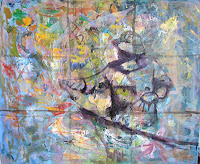 I drew my grid of thirds and sketched in the farmer so that his face was at the northeast sweetspot and his brightly lit hand was on the southeast sweet spot. The worker is corralling the cranberries by pulling the rope with his right hand while detangling weeds with his left. Next I fill in his overalls and made drawing corrections.
I usually use a wildly colorful canvas like this and when I get to this point, I often look at the painting and think that I like it just like it is and that I ought to stop. I like the darkest dark silhouetted against the colorful ground. Of course if I was radical enough to do it, I would get rid of the grid lines, then call it done!
I press ahead by grabbing a big brush and filling in the background, letting some of the undercolor show through. I started at the top using a mixture of permanent rose and naples yellow, gradually converting the pink to cad red and the naples yellow to cad yellow for the foreground. I mixed flesh tones for his face, arms and hands.


