Showing posts with label fruit. Show all posts

Wednesday, January 7, 2015

Market Square

A few months ago, I put a sharp corner of a framed painting through the middle of a large (30 x 48 inch) in-progress painting.   I may have shared that sad story back when it happened?   I pulled the ripped canvas off the stretcher bars, sized up a nice new length of gesso'd linen, and stretched it again.   I toned it with a mid-value neutral color.  That was several months ago - and there it sat.    The weather was nice as a plein air painter, I enjoyed plenty of beautiful days outside.

Market Street - Stage One


As soon as the temperatures started to cool I turned my attention to the studio.  I placed the BIG blank canvas on it.   I wanted to start planning out this large studio work.  I had the urge to include every attractive element I had been painting or photographing in the past few months. 


Market Street - Stage Two
What would that include?   Rustic buildings, stone walls, Irish farmhouses, festivals full of color, sunlit boats with pretty reflections, seals sunning themselves, bees buzzing around my pink and yellow zinnias, fireworks, city skyline.  Very exciting! This was the brainstorming phase of composing the piece.   I guess I could have jammed in all the attractive elements I had been envisioning, turning it into a fantasy painting, but realistically I needed to decide on a theme.

I did some sketching and printed a few of my favorite festival and marketplace photos, assembling a horizontal collage of scenes that were attractive to me.   I worked on building up a dark and light pattern that was appealing.    I wanted a "random - but planned" series of "lightest lights."    

Even as early as Stage One image above, the abstract dark and light pattern is visible.   The warm afternoon light highlights the old village buildings and market umbrellas.  The light spilled over onto the street, giving the illusion of a bright glare.   The stone archway on the left framed the bright light of the next alley over.   The shadows would be cool and blue, but not too dark.   Generally, even the shadow areas of a cityscape with bright warm light benefits from the reflected light.   The light tends to bounce around and provide ambient light even to the shadow areas.   (Photographs do not record this reflected light by the way - that's why "from life" painting is so much better!) The color temperature scheme (warm light and cool shadow) and the shadow directional scheme (late afternoon backlighting)  would be important supporting information.
Sunlight String
This painting has been on and off the easel for four months so there were several stages of progress.   I won't share them all but one thing I did was to use a sun string to guide the direction of my sunlight.   I attached a long piece of wood so that it pointed high up above the large canvas.  I tacked a long piece of string to the top of the wood.    As I painted the lighted areas, I stretched the string tight and that showed the angle of the rays of light coming from my "pseudo sun" at the top of the wood.   I wish I took a better photo but in the narrow photo, the wood and the string are somewhat visible.   This method would be useful if you aren't painting on site, or if you were on site but the light changed dramatically before packing up.


Market Square
I guess I like the anonymity of the figures.   I also love the idea of supporting the growers, buying their fresh products and turning that into a culinary comfort for their family. So where is market square, who are these people and why two thoroughfares?


Wednesday, November 12, 2014

My First Persimmon

It was class number three (of four) with painter and teacher Eli Cedrone and I arrived a little late and unprepared.   I hadn't brought any objects for a still life painting.   (Now that I am older and wiser, I was not sweating it however -  I knew that between my painting bag and my car, I would be able to come up with some objects.)

Persimmon and Tomato Set Up
As it turned out, my classmate had extra fruits and vegetables, and she invited me to help myself in creating my still life.    Had it not been for her generousity, I would not have gotten a chance to study my first persimmon. 

What is a persimmon?   It's a golden yellow oval fruit with a flavorful, smooth texture.  It's a healthy delicacy native to China and is used in cookies, cakes, muffins, puddings, salads and as a topping in breakfast cereal.   At this writing, I still haven't tried one yet.

Persimmon and Tomato
I placed a persimmon and a tomato on my fabric (my sweatshirt) trying to have them overlap and throw shadows that would make a pleasing abstract pattern.

The warm orange and red of the fruit picked up lots of light and even cast light and color on each other.   Although I didn't see their colors reflected on the fabric, I pretended it did and spread some of the color into the neutral gray for more excitment.

I bought my own persimmon on the ride home and am waiting for it to ripen on the counter.    I'm hoping I like it...I'll let you know!


Wednesday, November 5, 2014

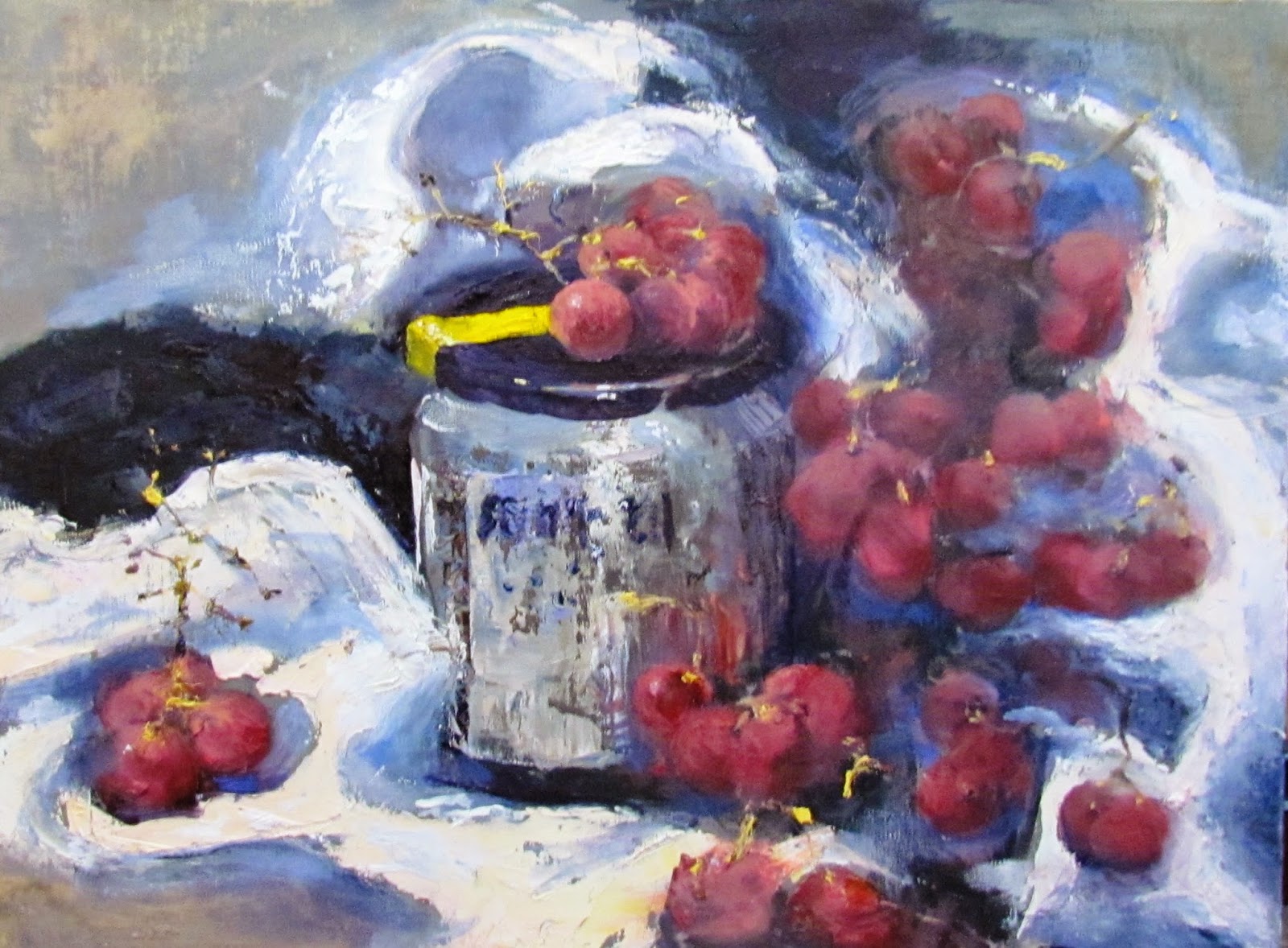
A Jar and Grapes

Red Grapes and Jar Still Life
I was in Session One of a workshop with one of my favorite artists from the New England region, Eli Cedrone.   She had sent out a lesson plan in advance of the class which included some interesting YouTube links for reference. 

Abstracted Thumbnail
American Artist Richard Diebenkorn was influenced by the work of Paul Cezanne and Henri Matisse.   He was drawn to their bold palette, the flattening of the picture plane and the minimal blending of color. He was interested in the geometry of a space – be it a still life, a field seen from above or an interior with figure. It is that convergence of lines and angles, forms distilled to their primary shapes, that connects his figurative paintings to his abstractions.

Eli challenged us to incorporate our twist on Diebenkorn's simplification and abstraction.  The mission was to render a non-representational depiction of our chosen still life set ups and to come up with a more striking and interesting composition. 


A Jar and Grapes - In Progress
As always, I love an art challenge and Eli's creative lesson plan challenged my status quo. With a 12x16 canvas staring at me, I started thinking that a few red grapes and a jar of Ikea pickled herring (my lunch) would be a weak and less-than-thrilling painting.   However, the objective of designing the painting instead of painting the subject exactly as designed, saved the day.

I decided to "split" the canvas into three zones.  Using the viewfinder I made three independent views of the grapes and jar set up.   I was trying to make a black and white abstract that had nice variation, without yet thinking about how this would become a red grape and jar still life.   (Important:  The composition makes or breaks the painting)   We next did a flat line drawing of the design.  By the time paint was applied, the three vertical zones were interleaved.   At this point, the actual set up in front of me was only for color and shadow reference, because my black and white thumbnail was my composition blueprint.


A Jar and Grapes - Loud and Loose
Here is the end product;  more loud and loose than usual.

BUY NOW

Monday, November 4, 2013

Basket of Apples

Basket of Apples
I dropped into a painting group a couple of days ago and there were multiple still lifes set up.   I should have worked on the still life that would have been more difficult for me.    It was a high key collection of objects in blues and oranges.  I elected to have more fun and do the big basked of apples; they were mac's afterall :).     I used a smooth clayboard substrate and a relatively small brush to rough in the drawing.   I used a paper towel to wipe out and fine tune the placement and size of the apples.   Although the spotlight on the setup was warm in tone, I like my cool lights these days, so I used my naples yellow for the lit portions of the basket and I used warm burnt sienna for the basket shadows.   I recently added some of Gamblin's Radiant Magenta to my palette (until I can get some more Permanent Rose).   The Radiant Magenta is nothing like Permanent Rose since it is lighter in value and opaque.   I mixed it with my Cad Red to apply the lit tops of the red apples.

As I look at the photo now, I realize that the red apple in shadow is too red.   I will pull some of the shadow color behind it to subdue it somewhat.   Let me know your comments!

BUY NOW

Tuesday, June 25, 2013

Daniel Keys Demo at Regis College

With another year of phenomenal success behind him, Daniel Keys just wrapped up two weeks on the East Coast, culminating in a painting demonstration held at Regis College in Weston, MA.   I was particularly psyched to learn of this venue because I graduated from the school, oh so many years ago.   If you have ever been to Regis, you know that the main building is College Hall, a grand stone building with pillars and archways that no doubt had attendees marveling at the beauty of the place.   The building may have been the first beautiful observation, but after just three hours, Daniel had created his own beautiful creation.   The crowd numbered roughly fifty, men and women ranging in age from twenty to eighty.   We learned that an instructional DVD was to be filmed as we observed the demo.   We were asked to hold questions or record the question to be addressed at appropriate points in the demo, so that the filming would go more smoothly.

It was no less enjoyable watching Daniel paint this year, even though I saw him paint a year  Like all of us who paint, a continuous evolution occurs.    He is trying different colors (like King's Blue), techniques (dry brush), mediums (walnut oil) and planning new subject matter.   

The two aspects of Daniel's painting that I find the most fascinating are:

The loose initial strokes made with large wide brushes approximate the color and shadows and look almost messy and haphazard.  Section by section this looseness is transformed with precise and economical strokes that bring laser focus to each element;

Keys Set-up, Palette & Painting
Secondly, the care taken to mix pristine, unpolluted color.   This includes the discipline of rinsing brushes in between strokes.    The photo doesn't lie.   Look how fresh and clean the palette pools of color are!   No wonder the painting is also bright and fresh.


.

Tuesday, June 4, 2013

Mangos!

Mangos I
Have you ever eaten a fully ripened, just picked mango?   I hadn't until last Tuesday when we arrived in Vieques, Puerto Rico.   What a special treat!  The sweet, juicy flesh of the fruit was very similar to a perfect peach, and the aroma was unbelievable. Our casita was surrounded by mango trees weighed down with these bright, heavy fruits.   We were invited by our hosts, Hector and Mary to help ourselves to the fruit.   The only caution was to never try to get to a freshly fallen mango if their horses were out.  The horses would win every time.  

Mangos II

We witnessed firsthand the horses zest for the fruit.  We heard a mango fall with a thud.  The closest of the three horses - pets of the Inn - made a beeline for it.  He made a precise nibble at the edge of the mango's skin then swung his head around in circles which took the skin off like a spiral.   He then took the whole fruit into his mouth, juices pouring out.


Mangos III
With all this attention on mangos, it became a prime topic of the watercolor studies that I did on this vacation.  The strap shaped leaves were sunlit and warm green, forming star patterns just above the fruit clusters.    I did several studies of the mangos and I look forward to working on an oil paint version now that we are home.


Mangos IV

Mangos V

Tuesday, June 19, 2012

A Key Workshop Experience - Days Three and Four

The third and fourth days of the Daniel Keys oil painting 
Teacups, Fruit and Flowers
workshop focussed on still life.     Antique teacups and fruit were added to the floral displays from day two.    Daniel set up a large canvas, 16x20 inches, and painted a beautiful composition of teacups, begonias, yellow pansies and fruit.   The lighting scheme was cool light and warm shadows and he worked it with clean, bright color over the two days.

For me, having painted the purple and yellow pansies on the previous painting, they were much easier this time around.     I nudged a pansy down into the left teacup to create a shadow inside.  Daniel thought it was a neat idea and did the same to his set up.

I tried to stay in step with his painting by executing the floral elements and greenery first. The values contrast of the pink impatiens light and shadow is a definite improvement over my past florals.   We also worked on painting the negative spaces around certain leaves and stems. The dahlia may be too dominant from a composition perspective, but it was good practice setting in each row of petals from outer to inner.  

The teacups that Daniel painted had gold leaf trim.   My teacups didn't have gold, but I liked it so much that I added it.   The gold on the darker sides of the cup was made from cad lemon, terra rosa and light green.   The gold highlight was cad lemon and cad yellow deep.

I can see that I will have to come back to this painting for a few details, like the shine on the middle apple and the cup handles and any other comments that I get from readers.

What a worthwhile experience!   I have lots of notes on techniques and color that I will be trying in the near future.  It was a week packed with learning and I have an even greater admiration for a rising star in the art world in Daniel, and I met great group of new friends who paint.

Sunday, June 17, 2012

A Key Workshop Experience - Day One

I attended a four-day, thoroughly enjoyable - workshop this week with a masterful young artist, Daniel Keys.    Not only is Daniel producing incredibly beautiful art, but he has a natural talent for teaching, sharing information in clear and understandable terms.    On the previous weekend, living legend, artist Richard Schmid dubbed Daniel the artist to watch.  I consider myself very lucky to have had this opportunity to learn from and paint with this remarkably accomplished phenom.

Click here to get a closer look at Daniel's art.
http://danielkeysfineart.com/

My Easel at Beach Rose Inn Side Garden
The first two days were to be focussed on the Cape Cod landscape.   The charming Beach Rose Inn in West Falmouth was a perfect backdrop for capturing on canvas a gorgeous June day on Cape Cod.   The roses, shasta daisies, and peonies were in full bloom decorating the grounds, and providing a variety of floral subjects.    Other choices were a koi pond with lily pads (and yes, the frog sitting on a lily pad), rustic cottages with flower boxes, and centuries old cedars.


Planter, Lantern and Spring Greens
The multitude of Spring greens, a blue speckled pottery planter and wrought iron path lantern were the elements present in the scene I chose.  On my palette I had introduced some colors that were new to me, like Transparent Oxide Brown.   It was a bit arduous - but rewarding - to not only try the new colors, but to adhere to the discipline of applying color shapes in the methodical process that Daniel had demonstrated in the morning.     The warm undertones of the transparent brown are still visible.   Using a nice clean blue has resulted in a pot that is a bit too blue.   I'll most likely tone it down with a glaze in a few days.   Here is my painting from day one of the workshop.

Thursday, March 22, 2012

Spring!

I did something crazy today.   I used a white canvas.
What led to this unusual event?
Hyacinth, freesia and lemons set up
  1. I observed that my daffodil bulbs were within days of opening,
  2. I splurged on some bright yellow freesias and fragrant purple hyacinths at the greenhouse,
  3. A nice, new stack of lily white canvases arrived in the mail,
  4. I watched Daniel Keyes transform a blank canvas into a stunningly colorful fruit and floral still life on Youtube.
Spring!   A fresh new start.  A snow white canvas.  A great day to mix up a spectrum of yellows and purples on my palette.

I arranged the flowers in a mid-sized clear glass vase.   I pressed a bright white cotton linen cloth and grabbed two lemons.   I liked where this was going.   I enlisted my very willing composition expert - my husband - to help me create the set up.  To the right is a photo of the set up.    In reality, the shadows were not this blue, but rather they were lavender.

Stage 1- Sketch and shadows
After sketching in a grid of thirds and the outline of the flowers in diluted raw sienna, I studied the big shapes.  One of the things I liked best about this set up is the pattern of shadows - big fuzzy circles, triangles and quadrilaterals.   There also were some nice feathery stem shadows that overlapped other shadows.   In the places that there was overlap, the shadow was darker - but just slightly.  

The darkest dark was the shaded side of the purple hyacinths.   The freesia stems were also dark, but I decide to wait until I have at least a couple of coats of paint on the background so as to not start dragging green through my nice white linen....so unlike me.  The white-on-white stripes on the linens were so striking that I wanted them to play a role instead of just blocking in a background of light and shadow.  This was a bit scary, because the stripes were standing out and were a bit distracting throughout the painting process.    My plan was to continue to glaze over the stripes until they sat back properly.
Stage 2 -
Linen Stripes and Block in

Stage 3 -
 Tablecloth and background glaze

Stage 4 -
Stems with Buds
The linen stripes continue to show through the layers of glaze.  The end result should be an understated hint of stripes, not the pronounced look of Stages 4, 5 and 6.  I want the lightest yellow of the freesias to be painted last with thick buttery yellow.  

Stage 5 -
Lemons and Freesia Petals
The front lemon was brightly lit except for a slight shadow cast from the linen at the bottom.  The rear lemon was quite dark and as you can see, as of Stage 6, it was still too light compared to the photo at top.
Stage 6 -
Hyacinth highlights
Each of these stages were done on consecutive days.

Stage 7 -
Freesia Petals and Lemons


This last picture, Stage 8, is close enough to complete that I will put it aside, and revisit in a week or two.  Comments and suggestions welcome.

Spring Blooms with Lemons