Showing posts with label study. Show all posts

Thursday, May 7, 2020

Pine Cone Branch

Scrub Pinecone

I love to look at all kinds of artwork and I receive some daily collections in my email.   A recent painting of a single apple grabbed my attention and reminded me that sometimes an ordinary object in thick oil paint can be so beautiful.   With a painterly touch, it can even rival a more complex or busy scene.  

During spring clean up, pine branches are everywhere - a very ordinary sight in New England.  Depicted in an oil painting, it seems much more than bland and ordinary.    This is especially true if the bright spots have pink and blue and mint and lavender!

Tuesday, April 4, 2017

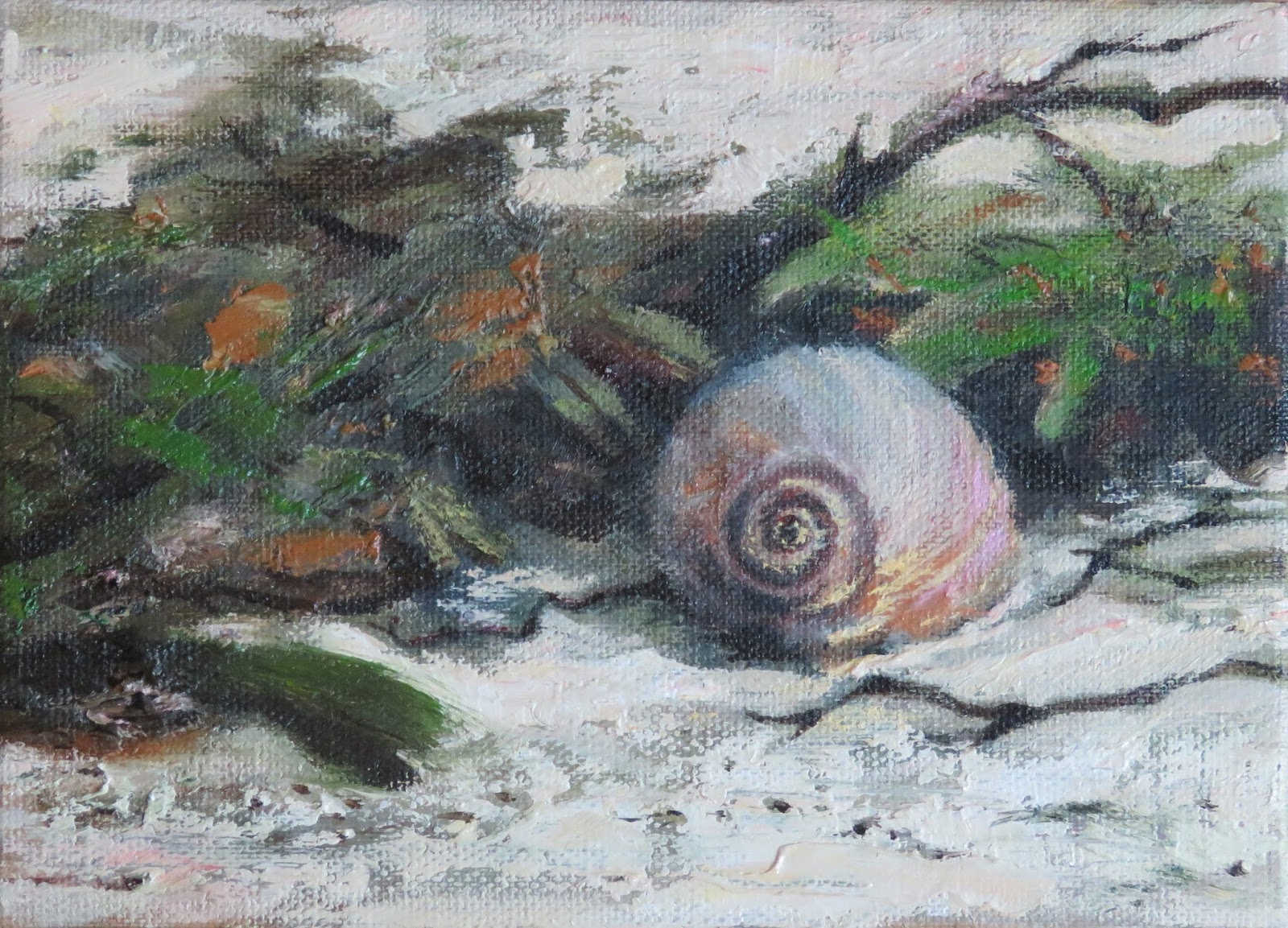
Northern Moon Snail Shell

Northern Moon Snail
The tide line is always changing and you never know what will wash up along with the average piles of seaweed.    My eastern facing New England beach is no Sanibel in terms of the amount or quality of shells, but every so often a perfectly undamaged shell of a New England species presents itself.   This is a "Northern Moon Snail" shell.   Here it sits among a colorful variety of seaweed and debris. Closer scrutiny shows a lovely array of colors, blue, gold, yellow, peach, brown and white.

Thursday, January 7, 2016

First Snow of the Season

First Snow of the Season
This week an arctic blast finally pushed into New England.  The frigid temperatures, "warm" ocean water and wind whipping from the north resulted in several hours of "ocean effect" snow. Similar to summer fog, the ocean moisture blanketed the shore with swirling flakes while just a ten minute drive inland it was a bright, sunny sky.   This constituted the first measurable snow for the season - which got me thinking "snowscape."   I set up at the Daniel Webster Audubon in Green Harbor, planning to paint snow.   Most of the snow was in the shadowy areas, although the terrain sloping away from the sun was also snowy and sufficiently illuminated. Many areas had already melted or evaporated, but that was fine; just enough snow!

I painted this same scene a year ago without snow so it may look familiar.     As a wildlife refuge, it is pristine as can be, and as such there is always hope of seeing deer, fox, and hawks.   The most action I saw today was in the air, a red helicopter practicing landing and takeoffs.      

BUY NOW

Check out the scene in the following video (4:30 sec).    

https://youtu.be/95yx1hzkPwI

Thursday, June 6, 2013

Beautiful Vieques

Esperanza Harbor I
Here are the last couple of tropical vacation watercolors.   Our lodging was just to the west of the small town of Esperanza and overlooked its harbor.   From the perspective of weather, our week fell in the "transitional" season, which meant periods of tropical clouds blowing through.   For most of the time however, the sky and water was a mesmerizing turquoise that is never seen north of the forty degrees latitude.


Esperanza Harbor II

Wednesday, June 5, 2013

Los Caballos - Horses

Horse Photo through Jeep Windshield
Esperanza Riding Club Herd from our Porch
There are painters that specialize in painting horses and I am not one of them.   On vacation in Vieques, Puerto Rico, there were opportunities to observe horses - everywhere.    We learned that there are approximately 9,000 residents on the island and there are 10,000 horses.   The single lane access to our lodging was a long, steep and winding dirt path down to the property.   Our first introduction to their predominance was when we turned onto this road in our 4WD Jeep, a very large horse was calmly ascending as we descended.  We came face-to-face with him on a stretch bound by thick brush and trees.  What happened next was obvious - and he fully expected it - we backed out and let him pass.  After all this was his property, not ours.

So although I have never really painted horses - like the mangoes - they were an integral and fascinating part of the landscape.   An objective view of their silhouettes revealed that they spend most of their time grazing, which looks like an upside-down (squarish)horseshoes.  These watercolors don't do justice to their muscular form and beauty, but it was fun to do these quick studies.


More horses


Bella

Looking West from Hector and Mary's

Friday, February 8, 2013

Figure Workshop Day Two

Thumbnails


On Day Two of my recent figure workshop, we were fortunate enough to have a live model.   The young lady, who was a high school student was very striking with strong classical facial features.  The instructor "dressed her up" by draping a warm red swatch of fabric over her lap as a skirt.  She also found a widebrimmed straw hat which she positioned forward enough to cast a sharp dark shadow over the model's eyes, accentuating her classic profile.


Black and White Study


We developed some thumbnail sketches, connecting the darks so that these accents would combine in a strong compositional design.  After the charcoal sketch we repeated the composition in black, gray and white.  Finally we painting the composition in color.


Live Model Color Study

Sunday, December 2, 2012

Plucky Cranberry Bog

Plucky Bog Set Up
There are dozens of cranberry bogs in the Marshfield and Duxbury area.  I try to be vigilant in watching for flooded bogs because I know that immediately following the flood, the cranberry thrashing and crimson harvest will occur.   I wish I knew the local bog harvest schedule because these bogs are tucked into various backroads that aren't visible from my regular routes.  


Plucky Bog First Painting Stage One
When I haven't been able to find a flooded bog, there are always the non-flooded bogs - the scene chosen on this day.

Plucky Bog First Painting Stage Two
The "Plucky" cranberry bog is located on East Street in Duxbury and it runs alongside Route 3.   Aside from the constant whiz of highway traffic, the spot was perfect for painting a typical Southeastern New England cranberry bog scene.     It was not flooded, but rather it was moist, peat-rich, and dark magenta color. 

The color shown in the Stage One painting depicts a magenta shade that was too light and too intensely purple.  The morning sun was to the east and it was casting light on the far grassy bank.   There was a pumphouse on the other end used for feeding the water channels that surrounded and cut through the bogs.


I started a second round of changes lightening the sky and adding the jet contrails.  I also changed the color of the bog, making it much redder.   It was still not right. Although colorful, I though it was too red, so I put it aside.  I need to come back to this one.


Plucky Bog Second Painting Stage One
I grabbed another canvas and turned toward the south.  

Really accomplished artists would never begin another painting for the reason I did at this point.  The reason was that I had a lot of paint on my palette and I didn't want to waste it!   

Plucky Bog Second Painting Stage Two

Quick studies with leftover paint mixtures can be pleasant surprises and this was one good result I think.  


The painting that got the least amount of time turned out the best.   I think it is true that warming up can be a valid exercise for painting as it is for anything else.  It can help a painter get into a groove, work out some flaws and can result in a fresher more spontaneous result.   


Saturday, December 1, 2012

Built in 1923 - Study

It was a perfect fall plein air day in Marshfield.  We set up at a sunny local spot at the bottom of a grassy hill adjacent to the Furnace Brook in Marshfield, MA.    An abandoned building sat atop the hill with the words "Built in 1923" engraved in mortar over the front door's roof peak.   What was this building anyway?   Back at the computer later that day, and despite searching the online land records and town municipal building information, I was not able to determine what the original use was for this old building on Hatch Street.  My guess was that it had been a school or municipal building.  It is now located right next to a new modern school.  
Hatch St Building Built in 1923
What attracted me was the building's architecture.   It had red brick facade and large arched windows, but a closer look revealed that the building was boarded up with plywood on some of the broken windows. From the bottom of the hill looking up through the autumn color though, the gracefully arched windows and roof line looked almost regal.  Once something becomes the center of interest of a painting, its status is instantly elevated, no matter what it really looks like.

This is just a quick study, but I am considering doing a larger studio painting using this and my photos for reference